
| Interview |

Interview with Stéphane rodrigues and Elsa Bernard
With the upcoming release of The European Defence Union, this English edition provides timely analysis of the EU’s evolving defence framework.
At a critical geopolitical moment, this new edition considers the developments that occurred in strengthening European defence in 2025, amid an increasingly concerning security environment for Europe, including the new mechanisms established by the European institutions to finance European defence; the proposal to establish a so-called ‘Military Schengen’ and the new European Defence Industry Programme (EDIP)
These various actions signal a shift toward more coordinated and more European defence spending.
In this interview, we discuss whether these new instruments represent a structural turning point for EU defence integration.
Regarding EDIP : By promoting joint procurement, reducing external dependencies and establishing a legal framework for long-term armament cooperation, EDIP may mark a decisive step in the construction of a genuine European Defence Union.

One of the core objectives of EDIP is to foster ‘more, better and more European’ defence spending. In practical terms, how does the Regulation encourage Member States to move from fragmented national procurement to coordinated and common investments?
Regulation (EU) 2025/2643 of the European Parliament and of the Council of 16 December 2025 establishing the European Defence Industry Programme and a framework of measures to ensure the timely availability and supply of defence products (‘EDIP Regulation’ – OJ L, 2025/2643, 29.12.2025) provides various ways to foster the common procurement of defence products. In particular, access to EU funding (EUR 1.2 billion for 2026–2027) is subject to common procurement actions involving at least three Member States or a new common entity, called ‘Structure for European Armament Programme’ (SEAP), involving at least three members, of which at least two are Member States (see Article 41). Where Member States purchase defence products from a SEAP, that procurement shall be considered as a contract awarded by a government to another government excluded from the application of Directive 2009/81/EC on the coordination of procedures for the award of certain works contracts, supply contracts and service contracts by contracting authorities or entities in the fields of defence and security (see Article 47). Moreover, the EDIP Regulation (see Article 53) authorises new cases justifying use of the negotiated procedure without publication of a contract notice (pursuant to Article 28(1), point (e) of Directive 2009/81/EC) where a contracting authority of a Member State establishes a new or joins an existing genuine defence cooperation initiative established by an international agreement or arrangement between Member States with the aim of convergence in military capabilities. Member States may also request the Commission to engage with them in a joint procurement or to act as a central purchasing body to procure defence products on behalf of, or in the name of, the interested Member States (see Article 15). Finally, at least four Member States can be engaged in a new ‘European Defence Project of Common Interest’ (EDPCI) consisting of collaborative industrial projects eligible for EDIP funding (see Article 35).
Regarding the objective to buy ‘more European’, for procurement, which is supported by EDIP, the cost of components originating outside the EU and associated countries shall not be higher than 35% of the estimated cost of the components of the end product (see Article 10(3) and (4)). This measure could be extended as part of the revision of Directive 2009/81/EC, which the Commission is due to propose in the second quarter of 2026. In its resolution of 11 March 2026 on tackling barriers to the single market for defence, the European Parliament calls on the Commission to propose ‘an ambitious revision’ of that directive (see point 16) and calls on the Member States ‘to apply a “buy European” approach, which prioritises the common procurement and increased production of defence products from the EDTIB, Ukraine, European Economic Area/European Free Trade Association (EEA/EFTA) countries and, as an additional complementary layer, other non-EU countries with which the EU has signed a Security and Defence Partnership, as this would ensure a predictable order volume for the EDTIB, drive up private investment in R&D for defence products, and help the EDTIB to deliver innovative defence products in sufficient volumes’ (see point 14).
Strategic autonomy has become a central theme in EU defence policy. How does EDIP aim to reduce dependencies on third-country suppliers while preserving interoperability with key partners such as NATO allies?
The words ‘strategic autonomy’ are not used as such in the EDIP Regulation. However, that concept is implicitly enshrined in the objective to strengthen the competitiveness of the European Defence Technological and Industrial Base (EDTIB). In that regard, eligibility criteria for acceding to EDIP funding should consider existing supply chains and industrial cooperation with non-associated third countries other than Ukraine and should allow capability requirements to be met. Therefore, for actions supported by EDIP, no component shall be sourced from third countries that contravene the security and defence interests of the Union and its Member States (see Article 10(3) and (4)).
Regarding interoperability with NATO, the establishment of a SEAP or a EDPCI must take into account the relevant activities carried out by NATO, such as the NATO Defence Planning Process, where such activities serve the security and defence interests of the Union. Moreover, the list of supporting actions eligible for EDIP funding includes the activities increasing or facilitating the implementation of military standards, in particular NATO standards (see Article 13).
The EDIP Regulation introduces a structured legal framework for long-term armament cooperation, including security of supply arrangements and potential military sales mechanisms. What are the most innovative legal features of this framework?
The provisions on security of supply are maybe the most challenging. They cover a large scope of actions: from the most practical and operational ones (like the acceleration of the permit-granting process for the timely availability and supply of crisis-relevant products and the facilitation of the cross-certification process) to the most sensitive for the Member States in terms of sovereignty; this is in particular the case with the new mapping of defence supply chains (see Article 56) and the activation of the security-related, or not, supply-crisis state. Special attention may be paid to the possibility for a Member State to ask the Commission to request an economic operator whose production site is located on its territory to accept, or to prioritise, a certain order of crisis-relevant defence products in order to address the severe difficulties that Member State or another Member State faces either in the placing of an order or in the execution of a contract for the supply of such products (see Article 66). On another note, to foster the EDTIB, a European Military Sales Mechanism is created, consisting in establishing a European Military Sales Catalogue and of managing and maintaining defence industrial readiness pools (see Article 36).
Beyond those technical provisions on security of supply, the EDIP Regulation confirms a new shift in the constitutional balance of defence competences within the European Union, encroaching on the intergovernmental mode of the common security and defence policy (CSDP).
What new financial instruments has the EU deployed to support these developments in European defence?
In March 2025, the ReArm Europe Plan/Readiness 2030 presented by the European Commission introduced new financial mechanisms to increase defence investment in the Union. Before that, the European Defence Fund (EDF) had been created to support research and development in the European defence industry, with EUR 8.8 billion under the 2021–2027 EU budget. The ReArm Europe Plan is more ambitious since it was presented as enabling EUR 800 billion in defence investment through various financial mechanisms. However, of the EUR 800 billion in question, EUR 650 billion are expected to result from the activation of the national escape clause provided for in the Stability and Growth Pact, which allows for an increase in national defence expenditure without these being taken into account in the calculation of the authorised 3% public deficit threshold. This projection remains speculative since there is no indication that states already burdened with high levels of debt are willing to increase their indebtedness further, even if they are now permitted to do so.
A further borrowing-based source of financing for defence equipment has already been established in the form of the Security Action for Europe (SAFE) Regulation, adopted in May 2025 by the Council of the European Union. That instrument enables the Commission to raise up to EUR 150 billion in capital markets and to give access to those funds to Member States through structured long-term loans, in order to enhance their military capabilities via common procurement from European defence industries. SAFE has received applications from nineteen Member States, with provisional funding allocations finalised last September, and sixteen states had their national investment plans already approved by the European Commission (the national investment plans of Czechia, France, and Hungary are still pending).
The Rearm EU Plan also provides for the reallocation of part of the Cohesion Funds available for the period 2021–2027 to productive investments related to security and defence. It could concern EUR 392 billion that the EU normally spends to equalise living standards across the EU, as part of its cohesion policy. The Commission has proposed several measures to make the use of cohesion policy funds for defence-related purposes more flexible and attractive, mainly through the 2025 mid-term review of the 2021–2027 cohesion programmes. Two regulations were adopted by the European Parliament and the Council on September 2025 creating new specific objectives for support from the European Structural and Investment Funds to finance industrial capacities in the defence sector and to allow for investments in resilient defence or dual-use infrastructure, including with a view to fostering military mobility (see below).
Another source of financing arises from the removal of the European Investment Bank’s internal rule previously restricting loans and guarantees for defence-related activities. This is important to secure financing but also to strengthen market confidence.
Finally, the ReArm EU Plan advocates for the improvement of financing conditions for private companies, from start-ups to major industry players, through the Savings and Investments Union strategy.
These are the new financial instruments that have been considered and/or mobilised over the past year in order to support the defence efforts of the Member States, including through resources drawn from the European Union budget. It remains to be determined whether this effort will be further consolidated within the framework of the forthcoming Multiannual Financial Framework, which is currently under negotiation. At this stage, the European Commission’s proposal to allocate EUR 131 billion to defence and space under the 2028–2034 budget would represent a fivefold increase in the resources devoted to these two policy areas. In addition, the appropriations earmarked for military mobility are expected to increase tenfold. This suggests a further strengthening of the EU budget’s contribution to the Union’s overall defence effort in the coming years.
Another new development is related to military mobility. What is at stake?
Since 2017, improving military mobility in the EU is a key priority for the Commission and Member States. In an action plan adopted in 2022, the EU insisted on the need to develop a well-connected military mobility network consisting of multi-modal transport corridors, including roads, railways, air routes, and inland waterways with dual-use transport infrastructure capable of handling military transports, harmonised rules, regulations, procedures, and digitalised administrative arrangements, enhanced sustainability, resilience and preparedness of civilian and military lift and logistical capabilities.
That strategy was confirmed in the Defence Readiness Roadmap 2030 adopted in October 2025. Following this, the Commission adopted a military mobility package in November 2025, consisting of a new regulation on military mobility and a Joint Communication paving the way for a ‘Military Schengen’, aimed at facilitating the rapid and seamless movement of troops, equipment and military assets to move quickly and smoothly across Europe. To support this objective, additional EU funding will be mobilised, including under the renewed Connecting Europe Facility (CEF) and through a proposed budget of more than EUR 17 billion for military mobility for the 2028–2034 period (see JOIN(2025) 846 final, page 8).
About the book
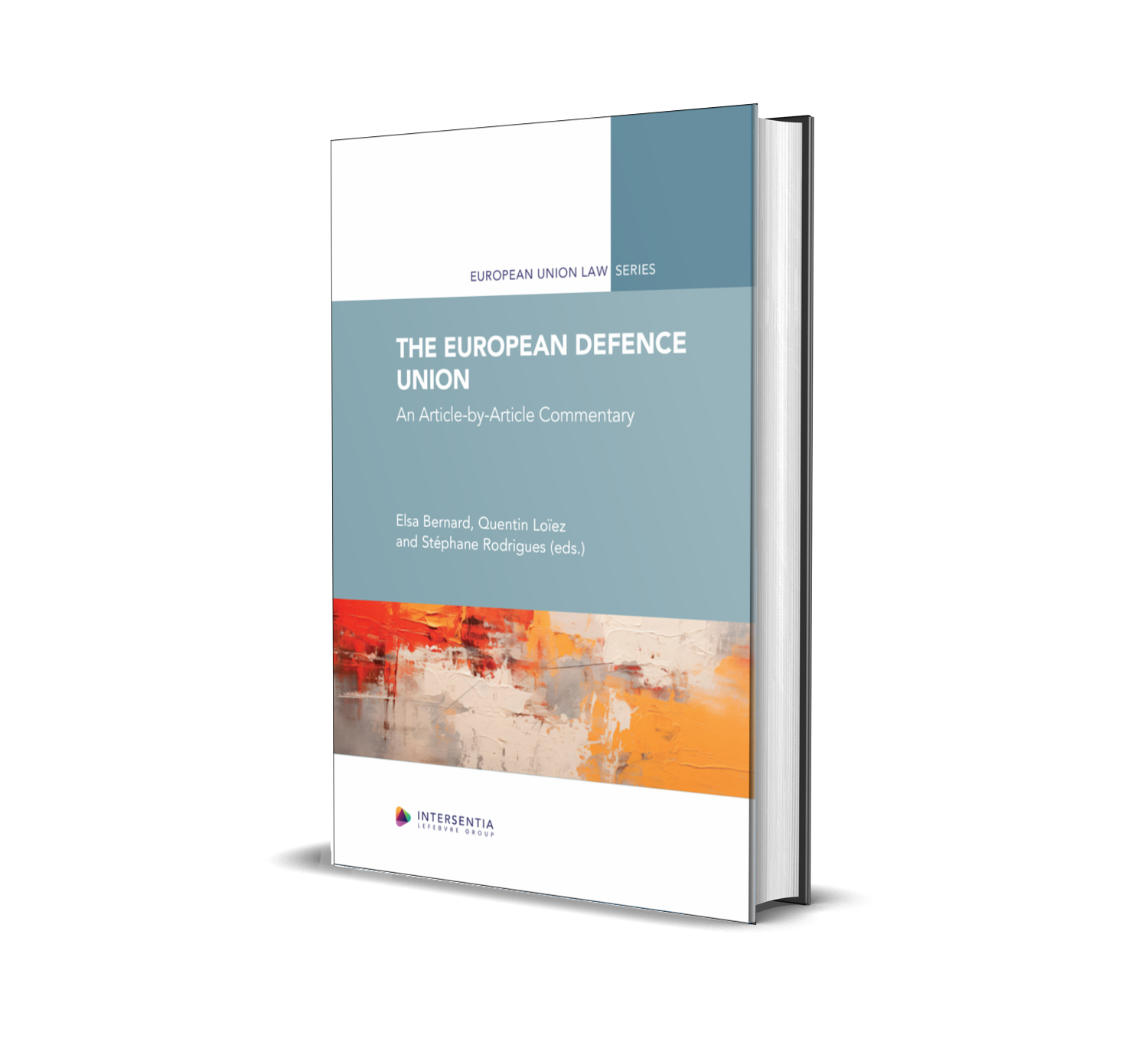
The European Defence Union
The European Defence Union has been under construction for several years within a worrying security context. It depends fundamentally on EU law: i.e. both the rules laid down by the Member States in the Treaties and those adopted by the European institutions, as the European Union’s approach is no longer limited to the highly intergovernmental Common Security and Defence Policy (CSDP). Instead, it encompasses and goes beyond the CSDP, extending to the so-called ‘Community’ or ‘supranational’ sphere, from which defence was long excluded.
Elsa Bernard, Quentin Loïez, Stéphane Rodrigues
April 2026
ISBN 9781839705755